

Revocable vs Irrevocable Trust in India: Which Protects Your Family Better?
A family sets up a trust to hold a property or a portfolio for the next generation, and assumes the job is done the moment the trust deed is signed. Then a question comes up later, during a dispute, an audit, or simply a change of mind, that the deed never quite answered: can the person who created the trust take the assets back, or are they gone for good?
That answer depends entirely on whether the trust is revocable or irrevocable, a distinction Indian law treats very differently depending on how the trust was created and what the deed actually says. This looks at what separates the two, how each is taxed, and which one actually holds up better when a family’s assets need real protection rather than just an arrangement on paper. AasaanWill helps families set up a Trust structured for what they actually need it to do.
Key Highlights
A trust is revocable only if the settlor expressly reserved the power to revoke it, or all beneficiaries capable of contracting consent, under Section 78 of the Indian Trusts Act, 1882.
Income from a revocable trust is taxed in the settlor’s own hands under Section 61 of the Income Tax Act, which removes most of the tax benefit of setting one up.
An irrevocable trust permanently moves legal ownership to the trustee, which is what gives it real strength against the settlor’s own creditors and later claims.
A revocable trust keeps the settlor in control, able to change beneficiaries or reclaim the assets, but offers little protection precisely because of that control.
Neither structure can be used to defeat an existing creditor or legal claim that already exists at the time the trust is created.
Most asset-protection and estate-planning goals are better served by an irrevocable trust. A revocable one suits situations where flexibility matters more than protection.
What’s Actually Different Between a Revocable and an Irrevocable Trust?
The two differ in one thing that affects everything else: whether the person who created the trust can undo it.
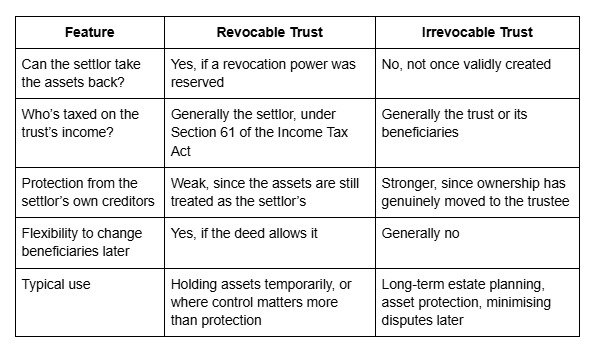
Every row in this table flows from the same root cause. Once a trust is genuinely irrevocable, the settlor has given something up permanently, and that’s precisely what makes it useful for protecting assets rather than just organising them.
What Makes a Trust Revocable or Irrevocable Under Indian Law?

A trust isn’t revocable just because the settlor calls it that in the deed, or irrevocable just because the word appears somewhere in the document. Section 78 of the Indian Trusts Act, 1882 sets out exactly when a trust can actually be revoked.
A trust created by a Will can be revoked at the testator’s pleasure, for as long as the testator is alive, since a Will itself only takes effect on death. Any other trust, whether created by a deed or orally, can be revoked only in three situations:
Every beneficiary who is legally capable of contracting consents.
The settlor expressly reserved a power to revoke when creating the trust.
The trust exists specifically to pay off the settlor’s debts, and the creditors were never told about it.
Outside these three situations, the trust is irrevocable by default.
This is why the wording of the trust deed matters more than its label. A deed that’s silent on revocation, or that doesn’t clearly reserve a power to revoke, generally creates an irrevocable trust whether or not that was the intention.
How Does Taxation Differ Between the Two?
Taxation is one of the key practical differences between revocable and irrevocable trusts. Under Sections 97 and 98 of the Income-tax Act, 2025, which came into effect on 1 April 2026, income arising from a revocable transfer of assets is generally taxable in the hands of the transferor. A transfer may be treated as revocable if it allows the assets or income to be transferred back to the settlor, directly or indirectly, or gives the settlor the right to reassume control over them.
In practice, this means that transferring assets to a revocable trust does not, by itself, shift the associated income-tax liability away from the settlor. The income may continue to be included in the settlor’s taxable income, even where the trust holds the assets and manages them on the settlor’s behalf.
An irrevocable trust may be taxed differently because the settlor has generally given up the right to reclaim the assets. However, irrevocability alone does not guarantee a tax advantage. The tax treatment depends on factors such as the trust’s terms, whether its beneficiaries and their shares are identifiable, whether the settlor retains any direct or indirect benefit, and the applicable provisions governing the taxation of trust income. An irrevocable trust should therefore be assessed on its specific structure and purpose rather than assumed to be more tax-efficient.
Revocable or Irrevocable Trust - Which One Actually Protects Family Assets Better?
An irrevocable trust can offer stronger separation between the settlor’s personal assets and assets held for beneficiaries. The key distinction is that, unlike a revocable trust, a properly structured irrevocable trust generally does not allow the settlor to reclaim the assets at will. However, the extent of protection depends on the trust deed, the rights retained by the settlor, and the circumstances in which the trust was created.
This distinction can matter when families want to manage business risks, provide for beneficiaries across generations, or establish clear arrangements for how family wealth should be held and distributed. By transferring assets to a trust and giving up the right to freely reclaim them, the settlor may reduce the extent to which those assets are treated as their personal property. However, an irrevocable trust does not automatically shield assets from every creditor claim, legal dispute, or challenge to the transfer.
Indian law places particular limits on transfers intended to defeat or delay creditors. For example, Section 53 of the Transfer of Property Act, 1882, allows certain transfers of immovable property made with that intent to be challenged by affected creditors. The Indian Trusts Act, 1882, also recognises circumstances in which a trust may be invalid against the settlor’s creditors.
An irrevocable trust is therefore best viewed as a potential tool for planned, long-term asset management and succession—not as a guarantee against creditors or a way to move assets out of reach once financial or legal problems arise.
When Does a Revocable Trust Still Make Sense?
A revocable trust isn’t pointless just because it offers weaker protection, since control and protection are genuinely different things to want. It tends to fit situations such as these:
Testing an arrangement before committing to it, where a family wants to see how a trust structure works in practice before giving up the ability to adjust it.
Holding assets for a minor or a dependant during the settlor’s own lifetime, where the settlor still wants the option to step back in if circumstances change.
Managing assets during a transition, such as settling an estate in stages, where permanence isn’t the goal yet. Our guide on best practices while creating a Will covers the simpler route this often gets compared against.
NRI families who want flexibility while they’re still deciding how an asset should ultimately be structured across jurisdictions, a question our piece on including foreign assets in estate planning goes into in more depth.
In each of these, the settlor is choosing to keep options open at the cost of the stronger protection an irrevocable structure would give. That’s a reasonable trade-off as long as it’s made knowingly, rather than by accident because a deed never addressed revocation clearly.
How AasaanWill Helps

AasaanWill helps families work out which structure actually matches what they need, rather than defaulting to one because it sounds more protective. Our team assists with:
Drafting a trust deed that clearly states whether it’s revocable or irrevocable, so it isn’t left to a court to decide later
Explaining how the choice affects both taxation and protection from creditors or family disputes
Structuring an irrevocable trust correctly where asset protection or long-term estate planning is the actual goal
Reviewing an existing trust deed’s revocation clause against what the family originally intended
Conclusion
A revocable trust offers flexibility, allowing the settlor to reclaim assets or modify the arrangement where the trust deed and applicable law permit. However, retaining these powers can affect both the taxation of trust income and the extent of separation between the trust assets and the settlor’s personal estate.
An irrevocable trust generally offers greater separation by limiting the settlor’s ability to reclaim or control the assets, making it a potential option for long-term family wealth management and succession planning. However, neither structure guarantees tax savings or complete protection from creditors and legal claims.
The right choice depends on the family’s objectives, the assets involved, and the balance between retaining control and providing for future generations. A carefully drafted trust deed, prepared with appropriate legal and tax advice, is essential to ensuring the arrangement achieves its intended purpose. AasaanWill can help families explore trust structures as part of their broader succession and estate planning.
Frequently Asked Questions
1. What is the main difference between a revocable and an irrevocable trust?
A revocable trust lets the settlor take the assets back or change its terms, while an irrevocable trust permanently transfers ownership to the trustee, with no right of recall.
2. Can a trust be revoked just because the settlor changes their mind?
Only if a power to revoke was expressly reserved in the trust deed, or all beneficiaries capable of contracting agree. Otherwise, the trust is irrevocable regardless of the settlor’s wishes.
3. Does an irrevocable trust actually protect assets from creditors?
Generally yes, since the assets legally belong to the trustee rather than the settlor going forward. It doesn’t protect against a creditor who already had a valid claim before the trust was created.
4. How is income from a revocable trust taxed?
It’s taxed as the settlor’s own income under Section 61 of the Income Tax Act, since a revocable transfer is treated as though the settlor never really gave up the assets.
5. Is a trust created through a Will automatically revocable?
It’s revocable at the testator’s pleasure only while the testator is alive, since the Will itself takes effect on death. After that, the trust’s own terms govern whether it can be changed.
6. What happens if a trust deed doesn’t mention revocation at all?
It’s generally treated as irrevocable by default, since Section 78 of the Indian Trusts Act, 1882 only allows revocation where a power was expressly reserved or beneficiaries consent.
7. Can beneficiaries revoke a trust on their own?
Yes, if every beneficiary is legally capable of entering contracts and all of them agree to the revocation. A single beneficiary can’t revoke it alone.
8. Is an irrevocable trust better for estate planning than a Will?
It depends on the goal. An irrevocable trust can reduce disputes and offer stronger protection during the settlor’s lifetime, but a Will remains simpler for a plain estate with no complex asset-protection needs.
9. Can a revocable trust be converted into an irrevocable one later?
Often yes, if the trust deed or the settlor’s later action formally gives up the reserved power to revoke, though this should be done through a properly drafted amendment rather than informally.
10. Does setting up an irrevocable trust avoid tax entirely?
No. It generally shifts who’s taxed, from the settlor to the trust or its beneficiaries, rather than eliminating tax. The applicable rates and rules still depend on the trust’s specific structure.
11. Can an irrevocable trust be challenged in court?
Yes, particularly if it was created to defeat an existing creditor’s claim, or if it wasn’t validly executed in the first place. A properly drafted and genuinely irrevocable trust is harder to unwind otherwise.
12. Is a revocable trust pointless if it offers less protection?
No. It still suits situations where the settlor wants to retain flexibility, such as testing a structure or managing assets during a transition, rather than locking in a permanent arrangement immediately.
13. Who holds legal ownership of assets in an irrevocable trust?
The trustee holds legal ownership and is bound to manage the assets for the beneficiaries’ benefit, while the settlor no longer has any ownership claim over them.
14. Does NRI status change how revocable and irrevocable trusts work in India?
The underlying rules stay the same, but NRI families often deal with cross-border asset structuring too, which can make the choice between flexibility and permanence more complex.
15. Can AasaanWill help decide between a revocable and an irrevocable trust?
Yes. AasaanWill helps families work out which structure fits their actual goal, whether that’s flexibility, tax efficiency, or genuine asset protection, and drafts the deed to match it clearly.
Disclaimer:
This article is for general informational purposes only and does not constitute legal advice. The information presented reflects the law as of the date of publication. For advice on your specific situation, please consult a qualified advocate.
Make sure your family’s trust actually does what you set it up to do. Get started with AasaanWill today.
Get in touch with us
Not sure about anything? We are just one phone call away. Book a free 15 minute consultation.

+91-8764447848
+91-8919084868

+91-8764447848
+91-8919084868
AasaanWill’s Privacy Commitment to you
We never use your data without your consent, or sell it to a third party.