
Name Change in Electricity Bill: Process, Including Transfer After the Owner’s Death
When a property changes hands or a parent passes away, the electricity connection often remains in the previous owner’s name. Payments keep going through fine, so it’s easy to let it sit that way for years. But an electricity connection that’s never been transferred can turn into a real problem later, when a new owner can’t get a loan processed, or legal heirs find the connection frozen in a dispute they didn’t expect.
The good news is that changing the name on an electricity bill is a routine request every DISCOM handles. What changes is the paperwork once the account holder has died, since the transfer then has to establish who’s legally entitled to take over rather than simply confirming that a sale happened. This blog covers the usual process, what’s different after a death, the documents either route needs, and who’s actually allowed to apply. AasaanWill helps families put together the legal heir certificate or succession certificate a death-related transfer often depends on.
Key Highlights
Changing the name on an electricity bill, whether after a sale or a death, means applying to the local DISCOM, not a court or a municipal office.
Each state’s electricity regulator issues its own Electricity Supply Code, so the exact form, fee, and documents can vary by state and even by DISCOM.
A routine transfer after a sale mainly needs proof of ownership and a no-objection certificate from the earlier owner.
A transfer after death additionally needs a death certificate and proof of legal heirship, such as a legal heir certificate, succession certificate, or probated Will.
Any legal heir can usually apply, but the DISCOM may ask for a no-objection from the other heirs if more than one person is entitled to the connection.
Water connections follow a broadly similar process through the local municipal body, though the forms and documents differ from the electricity DISCOM’s.
How Do You Change the Name on an Electricity Bill in the Normal Case?
You apply to your local DISCOM for a name transfer, usually through its website or consumer service centre. Here's how it typically works:
Submit a name transfer (or change-of-ownership) application to your local DISCOM, online or at its consumer service centre. Most DISCOMs use this label, though the exact form and its number vary by state.
Attach the required documents: the sale deed or another ownership document, the latest electricity bill with all dues cleared, identity proof of the new owner, and a no-objection certificate from the person whose name is currently on the connection.
Wait for DISCOM verification, which may include a visit to confirm the meter and premises before the records are updated.
Check your next billing cycle for the updated name, since the exact timeline isn't uniform across states, so it's worth confirming the DISCOM's own stated turnaround.
That lack of uniformity isn't an accident. Section 50 of the Electricity Act, 2003 requires each state's own electricity regulatory commission, not a single central authority, to issue its own Electricity Supply Code covering billing and consumer service matters. In practice, this is why the name-transfer form, fee, and exact document list differ from one state's DISCOM to another's, rather than following one national rulebook.
What Changes When the Account Holder Has Died?

The transfer still goes to the same DISCOM, but it now has to establish who the legal heirs are instead of simply confirming a sale. A no-objection certificate from “the previous owner” isn’t possible anymore, so it’s replaced with proof of death and proof of legal heirship.
This matters because a DISCOM has no independent way of knowing who a deceased consumer’s heirs are. Where the applicant can’t produce that proof, the request is typically held up, not refused outright, until the right document is in hand. This is also where disputes between family members tend to surface, since more than one heir may reasonably claim to be entitled to the same connection.
What Documents Do You Need for a Death-Related Name Transfer?
The core documents overlap with a routine transfer, but a death adds its own requirements on top. Here’s how the two compare:
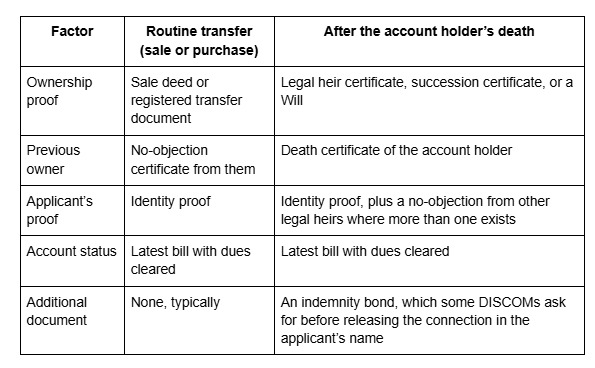
Not every DISCOM asks for every item in this list, and a few add their own, so it’s worth checking the specific requirements with the local office before applying.
Who Can Apply, and What Happens If the Heirs Don’t Agree?
Generally, any one of the legal heirs can apply, as long as they can show proof of that status and the other heirs don’t object. In practice, it’s usually whoever is living in the property or actually paying the bills who initiates the transfer.
Disagreement among heirs is where this slows down the most. If one heir applies without the others’ consent, the DISCOM may ask for a no-objection from them before proceeding, and if that isn’t forthcoming, a succession certificate from a civil court becomes the document that settles the question.
Does a Water Connection Follow the Same Process?
Broadly yes, though it goes through the local municipal corporation or water board rather than the electricity DISCOM, and the specific forms differ. The same underlying documents tend to apply: a death certificate and proof of legal heirship when the transfer follows a death, alongside the property’s tax receipts and ownership papers.
Because water supply is handled by local bodies rather than a small number of state DISCOMs, the exact process varies more by city than the electricity transfer does. Checking directly with the municipal corporation’s water or revenue department is usually the fastest way to confirm what’s needed in a specific case. Our property mutation guide covers the related process of updating the property’s own ownership records, which both utilities eventually rely on.
How AasaanWill Helps

AasaanWill doesn’t process the DISCOM or municipal application itself, but it helps families get the underlying legal heirship paperwork in order before they walk into that office. Our team assists with:
Preparing a legal heir certificate or succession certificate application for the relevant authority
Explaining which document a given DISCOM is likely to ask for, based on whether there’s a registered Will or not
Drafting a Will that names an executor, so utility transfers and other paperwork after a death have one clear point of contact
Helping with the broader property mutation process once ownership itself needs to be formally recorded
Conclusion
Changing the name on an electricity bill is a routine DISCOM request in the ordinary case, needing little more than an ownership document and a no-objection certificate. After a death, the same request needs proof of who the legal heirs actually are, which is where a death certificate and a legal heir certificate or succession certificate come in. The documents and fees differ somewhat by state and DISCOM, so it’s worth checking locally rather than assuming one process applies everywhere. Getting the legal heirship paperwork sorted early, with help from a platform like AasaanWill, is what keeps a routine transfer from turning into a drawn-out one.
Frequently Asked Questions
1. How do I change the name on my electricity bill?
Apply to your local DISCOM with proof of ownership, such as a sale deed, your latest bill with dues cleared, identity proof, and a no-objection certificate from the previous account holder. The exact form varies by state.
2. What documents are needed to change the electricity bill name after death?
Typically a death certificate, proof of legal heirship such as a legal heir certificate or succession certificate, identity proof of the applicant, and the latest bill with no dues pending.
3. Who can apply to transfer an electricity connection after the owner’s death?
Any legal heir can generally apply, provided they can show proof of that status. If more than one heir exists, the DISCOM may also ask for a no-objection from the others.
4. Is a succession certificate always required after a death?
Not always. A legal heir certificate or a Will is often enough. A succession certificate usually becomes necessary when heirs disagree or no other document settles the question clearly.
5. How long does an electricity name transfer take?
It varies by state and DISCOM, but the name typically appears within a few billing cycles of submitting a complete application. Checking the specific DISCOM’s stated timeline is the most reliable way to know.
6. Is there a fee for transferring the name on an electricity connection?
Yes, DISCOMs usually charge a modest processing fee, though the exact amount differs by state and sanctioned load. It’s worth confirming the current fee with the local DISCOM before applying.
7. Can the electricity connection be transferred without clearing pending dues?
Generally no. Most DISCOMs require all outstanding dues on the existing connection to be cleared before processing a name transfer, whether after a sale or a death.
8. Does the electricity bill need to match the property’s ownership records?
Not strictly, but mismatches can complicate things like loan processing or resale later, which is why updating the name after a death or purchase is worth doing even without an urgent reason.
9. What happens if the legal heirs don’t agree on who should hold the connection?
The DISCOM typically asks for a no-objection from the other heirs before transferring the name to one applicant. Without it, a succession certificate from a civil court usually becomes the document that resolves the dispute.
10. Is the process different for a water connection after a death?
It’s broadly similar but goes through the local municipal corporation or water board instead of the electricity DISCOM, with its own forms and, often, additional documents like property tax receipts.
11. Can a Will be used instead of a legal heir certificate for the transfer?
Yes, where the Will is present, it is accepted by the DISCOM as valid proof of legal heirship. In its absence, a legal heir certificate can be demanded.
12. Does an electricity connection automatically transfer when property is inherited?
No. The connection has to be separately applied for through the DISCOM. Inheriting the property doesn’t, by itself, update the utility records.
13. What if the deceased account holder has no surviving spouse or children?
The transfer still proceeds through whoever is established as the legal heir under the applicable succession law, which may include parents or siblings depending on the circumstances.
14. Can a tenant apply for an electricity name transfer after the owner’s death?
Generally no. The transfer is meant for the person legally entitled to the connection as owner or heir, not for a tenant, who typically has a separate arrangement for utility billing.
15. Can AasaanWill help with the paperwork needed for an electricity or water connection transfer after a death?
Yes. AasaanWill helps families put together the legal heir certificate or succession certificate these transfers usually depend on, so the DISCOM or municipal application isn’t held up for lack of the right document.
Disclaimer:
This article is for general informational purposes only and does not constitute legal advice. The information presented reflects the law as of the date of publication. For advice on your specific situation, please consult a qualified advocate.
Get the legal heir certificate or succession certificate your utility transfer depends on sorted properly. Get started with AasaanWill today.
Get in touch with us
Not sure about anything? We are just one phone call away. Book a free 15 minute consultation.

+91-8764447848
+91-8919084868

+91-8764447848
+91-8919084868
AasaanWill’s Privacy Commitment to you
We never use your data without your consent, or sell it to a third party.