

Mutual Fund Nominee After Death: How Legal Heirs Can Claim Without One
When someone in the family passes away, the paperwork that follows can be overwhelming. Bank accounts, property documents, insurance policies, and sometimes a mutual fund statement that the family knew little about. If that folio has no nominee listed, most families assume the money is locked away or lost forever. That is not true.
Legal heirs can still claim mutual fund units even when no nominee was registered. The process needs more documents and more time than a regular nominee transfer. Many investors opened folios years ago and never added a nominee. Some updated their bank accounts but forgot that mutual fund folios are registered separately. This guide explains the full process from start to finish, so you know exactly what to do and what to expect.
What Happens to Mutual Fund Units After the Investor Dies?
The units stay exactly where they are. They remain in the folio and become part of the deceased person's estate. Moving them to the rightful heirs is called a transmission.
When a nominee is registered, the process is quick. The nominee submits the death certificate and their own identity documents, and the fund house transfers the units. A nominee is not the legal owner though. They hold the units for the legal heirs and must eventually pass them on under succession law or the Will.
When there is no nominee, the fund house needs to confirm who the legal heirs are before it releases anything. That is the step that makes this process longer. This is also why having a registered Will makes such a practical difference for your family after you are gone.
Who Can Claim the Mutual Fund Units?

For a jointly held folio, the surviving holder takes over. They submit the death certificate and update the folio to their name. No major process is needed.
For a folio held in one name with no nominee, the legal heirs under Indian succession law can claim the units. Under the Hindu Succession Act, 1956, this is usually the spouse, children, or parents of the deceased. The Indian Succession Act, 1925 and the Muslim Personal Law applies to others.
If the investor left a registered Will, the executor named in that Will can start the transfer process on behalf of the people named as beneficiaries. If you are unsure about how legal heir status is established, you can read more about legal heir certificates and how they work.
Two Routes for Mutual Fund Transmission Without a Nominee
Fund houses follow SEBI and AMFI guidelines on this. The route you take depends on the total value of the folio with that fund house.
Route 1: Folio Value Below Rs 5 Lakh Per Fund House
For folios under Rs 5 lakh, most fund houses accept a notarised affidavit and an indemnity bond. You do not need to go to court.
Documents you Will need:
Death certificate of the investor
PAN card and Aadhaar of the person claiming
Bank account proof such as a cancelled cheque or passbook copy
Notarised affidavit confirming your identity and relationship to the deceased
Notarised indemnity bond signed by all legal heirs
No-objection letter from other heirs if more than one person has a claim
Route 2: Folio Value Above Rs 5 Lakh Per Fund House
For folios above Rs 5 lakh, the fund house needs legal proof of who the heirs are.
If the investor left a Will, you will provide copy of the Will with supporting documents.
If there was no Will, you Will need a succession certificate from a civil court. This involves filing a petition at a district court and can take several months. It is the standard requirement when no Will exists and the folio value is high.
Documents Checklist
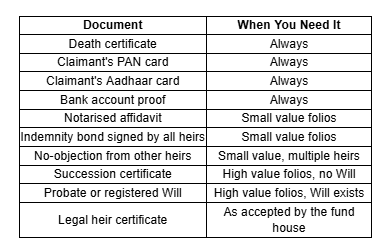
Each fund house has its own transmission form. Download it from their website or visit the nearest investor service centre. CAMS and KFintech are the two main Registrar and Transmission Agents(RTAs) in India and handle transmission for most fund houses.
How to Submit the Transmission Request for mutual fund folios?
Start by finding all the folios the deceased held.
You could go to camsonline.com or the KFintech website and search using the deceased's PAN number. Old email statements in the deceased's inbox can also list folio numbers and fund house names.
Once you have the list, check which fund house manages each folio. Download the transmission form from the relevant fund house or RTA website. Fill it out, attach all required documents, and get the ones that need notarisation done before you submit.
You can submit at the fund house office, the RTA service centre, or through a distributor if one was involved in the investment. After submission, the fund house reviews everything and either transfers the units to the claimant's new folio or redeems them and sends the money to the claimant's bank account, whichever the claimant prefers.
Small value cases usually take around 30 days once all documents are correctly submitted. Cases that need a succession certificate from a court can take several months.
Common Problems Legal Heirs Face

The process looks straightforward on paper. But when families actually go through it, they run into walls they did not expect.
Common problems include:
Nobody knows all the folios the deceased held, and some sit undiscovered for years
Multiple fund houses each run their own separate process, so the family has to manage several tracks at once
Heirs disagree on how to split the units, and the fund house Will not release anything until it is resolved
The deceased's KYC was never updated or the PAN was not linked correctly, putting the folio on hold
Families do not know the difference between a legal heir certificate and a succession certificate, and which one the fund house actually requires
Documents get rejected on the first submission because one signature is missing or notarisation was not done correctly
Don't Want to Handle This Process Alone?
Tracing folios, gathering notarised documents, managing court processes for a succession certificate, and doing all of this while dealing with a family loss is a lot to manage. Many families get a document wrong on the first submission and face rejections that push the timeline back by months. Getting it right from the start saves a lot of time and stress.
How AasaanWill Helps You with Estate Planning Needs
Mutual fund transmission is one of those processes that looks simple on paper but trips up most families at the document stage. AasaanWill helps you plan ahead so your family does not have to go through that. Our team assists with:
Create a legally valid Will that covers your mutual fund folios and other financial assets
Guidance on nominee registration and why it matters for each type of asset
Support with succession planning so your family has clear instructions after your death
Help understanding whether a succession certificate or probate is needed in your situation
End-to-end estate planning so nothing is left undocumented or unclaimed
Conclusion
Claiming mutual fund units after a death without a nominee is possible. It takes more time and documents than most families expect, but it works. Knowing which route applies, getting the right documents together from the start, and submitting them to the correct place prevents delays that otherwise go on for months.
The best step you can take today is to plan ahead. Adding a nominee to your folios and writing a Will that covers your financial assets takes far less effort now than what your family would have to go through without it. AasaanWill can help you get both done right.
FAQs
1. Can legal heirs claim mutual funds after death without a nominee?
Yes. No nominee does not mean no claim. Legal heirs can still get the units. The process needs more documents and takes longer than a transfer to a registered nominee.
2. What is mutual fund transmission after death?
Transmission is when the units of a deceased investor are moved to the nominee or legal heirs. Each fund house follows SEBI and AMFI rules on how this is done.
3. How long does mutual fund transmission without a nominee take?
For folios below Rs 5 lakh, it usually takes 30 to 60 days once all documents are correctly submitted. For folios that need a succession certificate from a civil court, the process can take several months.
4. What documents are needed to claim mutual funds after death?
You need the death certificate, the claimant's PAN and Aadhaar, and bank account proof. For small value folios, a notarised affidavit and indemnity bond are also needed. For high value folios, a succession certificate or probate is required.
5. What is an indemnity bond for mutual fund transmission?
It is a notarised document signed by the claimant and all other legal heirs. It confirms the claimant Will be responsible if any future claims come up on the folio. Fund houses accept it instead of a court order for folios below Rs 5 lakh.
6. What is a succession certificate and when is it needed for mutual funds?
A succession certificate is a document from a civil court that confirms who the legal heirs are. It is needed when the folio value is above Rs 5 lakh and no registered Will exists. You can read about how AasaanWill assists with succession certificate applications.
7. Can a legal heir certificate replace a succession certificate?
Some fund houses accept a legal heir certificate
8. How do I find out if a deceased person had mutual fund investments?
Search using the deceased's PAN on camsonline.com or the KFintech website. AMFI also has an unclaimed amounts tool. Old email statements from the deceased's inbox can help too.
9. What happens to mutual fund units if no one claims them?
They don't automatically disappear or get transferred to the government. Mutual fund units remain invested in the folio until the investor or their legal heirs claim, redeem or transfer them.
If a folio has no investor-initiated transactions for 10 years, but still holds units, it is classified as an inactive folio and can be traced through SEBI's MITRA platform.
Legal heirs can still claim these investments, even years later, by completing the required transmission formalities. However, forgotten investments can become harder to trace over time, particularly if old records or KYC details are missing.
10. Can I add a nominee to my mutual fund folio now?
Yes, and you should do it soon. Most fund houses let you add a nominee online through their portal or through CAMS or KFintech. Adding a nominee does not change ownership during your lifetime. It just makes the process far simpler for your family after your death.
11. Is a nominee the legal owner after the investor dies?
No. A nominee is a trustee, not the legal owner. They receive the units but must pass them to the legal heirs under succession law. When the nominee is also the only legal heir, this does not cause any practical problem.
12. Can a minor be a nominee on a mutual fund folio?
Yes. A minor can be nominated, but a guardian must be named at the same time. If the investor dies while the nominee is below 18, the guardian receives the units on behalf of the minor.
13. What if legal heirs disagree on how to split the units?
The fund house Will not release the units until all heirs agree or a court decides. A succession certificate from a civil court is the standard way to resolve this.
14. Does a registered Will help with mutual fund transmission?
Yes, it helps a lot. A registered Will that names beneficiaries for your financial assets makes the high value transmission process much simpler. It reduces the need for a succession certificate and gives the executor a clear legal basis to act.
15. Does AasaanWill help with mutual fund estate planning?
AasaanWill helps you write a legally valid Will that covers your financial assets including mutual fund folios. A properly written Will is one of the most effective ways to protect your family from the difficulties of the no-nominee transmission process.
Disclaimer:
This article is for general informational purposes only and does not constitute legal advice. The information presented reflects the law as of the date of publication. For advice on your specific situation, please consult a qualified advocate.
Start your estate planning with AasaanWill today so your family has clarity when they need it most.
Get in touch with us
Not sure about anything? We are just one phone call away. Book a free 15 minute consultation.

+91-8764447848
+91-8919084868

+91-8764447848
+91-8919084868
AasaanWill’s Privacy Commitment to you
We never use your data without your consent, or sell it to a third party.