

Form 15CA and 15CB Explained: How NRIs Can Repatriate Inheritance Money from India
An NRI inherits money from a parent’s bank account in India. It sits safely in an NRO account, but moving it to her own country needs more than a bank transfer. The bank asks for two forms she has never heard of before it will send a single rupee abroad: Form 15CA and Form 15CB.
These two forms exist because India wants to confirm that tax has been handled correctly before money leaves the country, even inherited money. Since 1 April 2026, the Income Tax Act, 2025 has renamed them Form 145 and Form 146, though banks and Chartered Accountants still mostly use the older names. This guide uses both together and explains what each form does, whether inherited money is actually taxed, and the usual steps and documents involved in repatriation. AasaanWill helps NRI families put a clear NRI Will in place for their Indian assets, so heirs have clearer succession documentation when they begin the repatriation process.
Key Highlights
Form 15CA (now Form 145) is a declaration the remitter files online, confirming tax has been paid or isn’t owed on money being sent abroad.
Form 15CB (now Form 146) is a CA certificate, generally needed for a taxable remittance above Rs 5 lakh under Part C, unless an Assessing Officer certificate supports Part B instead.
The Income Tax Act, 2025 renumbered three provisions: TDS deduction (Section 195 is now Section 393(2)), the Form 15CA/15CB reporting requirement (Section 195(6) is now Section 397(3)(d)), and the lower/nil certificate route (Section 197 is now Section 395(1)).
Inheriting money or property isn’t taxed in India, but selling inherited property later can trigger capital gains tax before repatriation.
NRIs can generally repatriate up to USD 1 million per financial year from an NRO account, subject to tax compliance and documentation.
Which part of Form 15CA (Form 145), A to D, depends on the amount and whether the remittance is taxable.
Your bank will ask for whichever forms apply, along with Form A2 and its own inheritance documentation.
What Are Form 15CA and Form 15CB?
Form 15CA, now Form 145, is a declaration filed online by whoever is sending money abroad, confirming that applicable tax on the remittance has either been paid or doesn’t apply. Form 15CB, now Form 146, is different: it’s a certificate from a practising Chartered Accountant, confirming the correct tax treatment, rate, and any applicable tax treaty benefit on that specific remittance, and it isn’t always required.
Both were renumbered under the Income Tax Act, 2025 and the Income Tax Rules, 2026, for any remittance made on or after 1 April 2026, with the core purpose of each staying the same. Because the older names are still in everyday use at most banks and with most Chartered Accountants, this guide keeps using both together, noting the new numbers where they matter for a filing made today.
Is Inherited Money or Property Taxed When You Repatriate It?

Inheriting money or property is not, by itself, a taxable event in India. There is no estate or inheritance tax here, so simply receiving an inheritance creates no tax bill.
The tax question arises separately, when inherited property is sold. The sale can attract capital gains tax, calculated using the original owner’s cost of acquisition rather than the inherited value.
The buyer is typically required to deduct this tax at source, under Section 393(2) of the Income Tax Act, 2025 (replacing Section 195 of the 1961 Act for payments from 1 April 2026), before paying the NRI seller. It’s this tax position, not the inheritance itself, that Form 15CA and 15CB are actually checking.
NRIs juggling assets both in India and abroad may also find our guide on including foreign assets in estate planning useful background.
The Four Parts of Form 15CA: Which One Do You Need?
Form 15CA, now Form 145, has four parts, only one of which applies to any given remittance. Parts A, B, and C all require the remittance to be taxable, the detail easiest to miss.
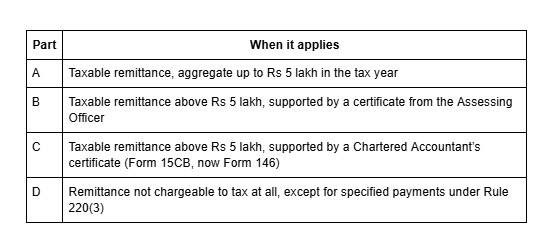
For plain inherited cash with no tax owed, Part D is usually the relevant section. Where tax is owed, such as after selling inherited property, it’s Part C with a 15CB (Form 146), or Part B instead if you already hold an Assessing Officer certificate, which the department’s own guidance confirms removes the need for a separate Form 146.
When Do You Need Form 15CB From a Chartered Accountant?
Form 15CB (Form 146) is generally required for a taxable remittance above Rs 5 lakh filed under Part C. Below that threshold, or where the remittance isn’t taxable, you file the relevant part of Form 15CA alone, no certificate needed. There’s also a middle route: an Assessing Officer certificate supporting Part B removes the need for a separate Form 15CB, even on a taxable remittance above Rs 5 lakh.
Tax-form requirements and your bank’s own documentation checklist are separate things. Even where Form 15CB isn’t required for your filing route, the bank may still ask for its own evidence of the inheritance, so confirm its checklist directly.
Step-by-Step: Repatriating Inheritance Money as an NRI
Get the inheritance documentation in order: the death certificate, a Will or legal heir or succession certificate, and proof of your relationship to the deceased.
Deposit the money into an NRO account, if it isn’t already there.
If property was sold, settle the TDS position first. The buyer generally deducts tax under Section 393(2) of the Income Tax Act, 2025 before paying you. If that’s based on the full sale value rather than the actual gain, apply for a lower or nil deduction certificate using Form 128 under Section 395(1), which replaced Section 197 and Form 13. Form 128 is the application. The Assessing Officer issues the certificate itself separately.
Get Form 15CB (Form 146) from a Chartered Accountant, if taxable, above Rs 5 lakh, and you aren’t filing Part B with an Assessing Officer certificate instead.
File Form 15CA (Form 145) online, selecting the part that applies.
Submit the applicable form acknowledgements and supporting documents to your bank, along with Form A2, so it can process the transfer.
How Much Money Can You Repatriate? The USD 1 Million Limit

Under the RBI’s FEMA rules for NRIs, an NRI can generally repatriate up to USD 1 million per financial year from an NRO account, including inherited funds and sale proceeds, provided tax is paid and the authorised dealer bank is satisfied with the documentation.
This limit runs per financial year, April to March, at the exchange rate applicable on the transfer date. Amounts beyond it generally need separate RBI approval, best handled with professional guidance.
How AasaanWill Helps
Getting the inheritance paperwork right from the start makes repatriation smoother later. Our team assists with:
Helping NRI heirs put together a Will that accounts for Indian assets, easing the eventual inheritance process for the family left behind.
Guiding families through the legal heir, succession certificate, or probate process needed before funds can be claimed or moved.
Pointing NRI families towards related planning resources well before an inheritance is underway.
Helping you understand what documentation your Chartered Accountant and bank will eventually ask for.
Conclusion
Inheriting money in India doesn’t create a tax bill on its own, but moving it abroad still runs through a specific compliance process. Form 15CA, now Form 145, confirms the tax position to the bank, and Form 15CB, now Form 146, where required, backs that up with a Chartered Accountant’s certificate, unless a Part B Assessing Officer certificate covers it already. The Income Tax Act, 2025 changed the numbers and some procedural detail, not the overall purpose, so knowing which part applies still saves significant time when the money is ready to move. AasaanWill can help you get the underlying inheritance documentation right, so heirs have a clearer starting point for repatriation.
Frequently Asked Questions
1. What is Form 15CA used for?
It is a declaration filed by the person sending money abroad, confirming tax on the remittance has been paid or doesn’t apply. From 1 April 2026 it is officially Form 145 under the Income Tax Act, 2025, though banks still require it under either name.
2. What is Form 15CB, and who issues it?
Form 15CB, now Form 146, is the certificate a practising Chartered Accountant issues, confirming the applicable tax rate and treatment for a specific remittance. It backs up Form 15CA, now Form 145, the remitter’s own declaration.
3. Do I need Form 15CB to send inherited money abroad?
Generally yes, if the remittance is taxable, exceeds Rs 5 lakh, and you’re filing under Part C. A non-taxable inheritance usually needs only Form 15CA (Form 145), and even a taxable remittance above Rs 5 lakh can skip Form 15CB if you’re filing under Part B with an Assessing Officer certificate instead.
4. Is inheritance money taxed in India?
No. Receiving an inheritance is not a taxable event in India, since there is no estate or inheritance tax. Tax can still apply later if inherited property is sold.
5. How is capital gains tax calculated on inherited property?
It is calculated using the original owner’s cost of acquisition, not the value at the time of inheritance, and the holding period is also counted from the original owner’s purchase date.
6. Does the buyer deduct tax when purchasing property from an NRI seller?
Yes. For a sale on or after 1 April 2026, the buyer must deduct tax at source under Section 393(2) of the Income Tax Act, 2025 (previously Section 195, 1961 Act) before paying an NRI seller, usually at a higher rate unless a lower deduction certificate has been obtained.
7. Can an NRI get a lower TDS rate on the sale of inherited property?
Yes. An NRI selling inherited property in India can apply for a lower or nil TDS certificate using Form 128 under Section 395(1) of the Income-tax Act, 2025, which replaced Form 13 under the erstwhile Section 197 from 1 April 2026.
The Assessing Officer considers the seller’s estimated tax liability and, if satisfied that the default TDS would be higher than the tax actually payable, may issue a certificate specifying a lower rate or amount of TDS. This can prevent TDS from being deducted on the full sale consideration when the actual taxable capital gain is substantially lower.
8. How much money can an NRI repatriate from India in a year?
Generally up to USD 1 million per financial year from an NRO account, covering inherited funds and inherited property sale proceeds, subject to tax compliance and documentation.
9. Which account should inherited money be deposited into?
An NRO account is the appropriate account for inherited funds and sale proceeds of inherited property held in India.
10. What documents does a bank usually ask for before repatriating inherited money?
Typically Form 15CA (Form 145), Form 15CB (Form 146) where applicable, Form A2, and documentation establishing the inheritance, such as a death certificate, Will, or legal heir certificate.
11. What happens if Form 15CA or 15CB is filed incorrectly?
Incorrect or missing filings can delay the remittance and may attract penalties, so it’s worth having a Chartered Accountant review the filing, especially where tax is actually owed.
12. Does Form 15CA need to be filed for every outward remittance?
Most remittances require it, though certain specified categories of payment are exempted under the relevant income tax rules. Inheritance-related remittances generally still go through the standard Form 15CA (Form 145) process.
13. Can inherited property be sold before repatriating the proceeds?
Yes, and this is common. The sale itself may trigger capital gains tax, which needs to be settled or certified before the remaining proceeds can be repatriated.
14. How long does it take to repatriate inherited money as an NRI?
Processing time varies by bank and by case, so it’s worth asking your bank for an estimate once it has reviewed your complete documentation. Gathering the inheritance documents beforehand is usually the longer part of the process.
15. Why do Form 15CA and 15CB now have different numbers?
The Income Tax Act, 2025 restructured and renumbered many provisions and forms from 1 April 2026. Form 15CA became Form 145 and Form 15CB became Form 146. The purpose and Part A to D structure are broadly the same, though remitters now use the current forms and updated portal process.
Disclaimer:
This article is for general informational purposes only and does not constitute legal advice. The information presented reflects the law as of the date of publication. For advice on your specific situation, please consult a qualified advocate and or a Chartered Accountant.
If you’re an NRI dealing with inherited assets in India, get the documentation right before repatriation becomes urgent. Get started with AasaanWill today.
Get in touch with us
Not sure about anything? We are just one phone call away. Book a free 15 minute consultation.

+91-8764447848
+91-8919084868

+91-8764447848
+91-8919084868
AasaanWill’s Privacy Commitment to you
We never use your data without your consent, or sell it to a third party.