

Estate Planning Lawyer in India: Do You Need One or Can You Go Online?
When people start planning their estate, one of the first questions they often ask is: “Do I need a lawyer to make my Will, or can I do it online?”
The answer isn't as simple as choosing one over the other.
A straightforward Will does not require a lawyer merely to be legally valid. At the same time, a Will is not something that should always be treated as a fill-in-the-blanks document. Your family structure, property, investments, business interests, beneficiaries and wishes can all affect how your estate plan should be drafted.
So the better question is:
Do you need a basic document, or do you need a personalised estate plan backed by legal expertise?
This is where professionally guided online estate-planning services have changed the way people can approach succession planning. AasaanWill combines the convenience of an online process with legal expertise, creating customised Wills and other estate-planning solutions around each client's circumstances.
Key Highlights
You do not generally need a lawyer merely to make a Will. For an ordinary Will covered by Section 63 of the Indian Succession Act, 1925, the Will must satisfy the applicable requirements for execution and attestation, including attestation by at least two witnesses.
The absence of a lawyer does not automatically make a Will invalid. What matters is whether the Will has been properly executed and whether it reflects the testator's genuine wishes.
Legal expertise becomes particularly valuable when an estate involves complex family circumstances, business interests, multiple properties, cross-border assets, Trusts or unusual distributions.
An online Will service does not have to mean a generic template. A professionally guided service can combine digital convenience with personalised legal drafting.
A Trust or broader succession plan may sometimes be more appropriate than relying on a Will alone, depending on the family's circumstances and objectives.
Will registration is optional under Indian law. Registration does not, by itself, make a Will valid or immune from challenge.
The right approach depends on the complexity of your circumstances and the level of personalisation and legal support you need, not simply on whether the service is online or offline.
Do You Legally Need a Lawyer to Write a Will in India?
No. A lawyer is not required merely to make an ordinary Will.
For a Will covered by Section 63 of the Indian Succession Act, 1925, the law lays down requirements relating to the testator's execution of the Will and its attestation by at least two witnesses.
There is no general rule that says a Will must be drafted by a lawyer to be valid.
But there is an important distinction between not needing a lawyer and not needing legal expertise.
A person can write their own Will. However, they are then responsible for deciding what to include, how to express their wishes clearly, how different assets and beneficiaries should be dealt with, and whether there are any issues that could create uncertainty or disputes later.
That is why the real question should not simply be whether a lawyer is legally mandatory.
It should be whether your circumstances call for professional, personalised estate planning.
What Makes a Will More Complex?
Not every Will requires the same level of planning.
For someone with a straightforward family structure, limited assets and clear wishes, the estate plan may be relatively simple.
But the level of planning can increase considerably when there are factors such as:
Multiple properties or significant financial assets
A family business or other business interests
Children from different relationships
Unusual or unequal distributions among beneficiaries
A desire to provide for a family member with specific needs
Significant assets held in different countries
NRI or cross-border succession considerations
A requirement for a Trust or other succession structure
Concerns about potential family disputes
Complex ownership or beneficiary arrangements
In these situations, the challenge is not simply putting someone's wishes on paper.
It is understanding the family's circumstances and choosing the appropriate legal structure to give those wishes effect.
Do You Need to Choose Between an Online Will and a Lawyer?

Not necessarily.
The traditional model of estate planning often involves finding a lawyer, arranging consultations and working through the drafting process directly with the legal professional.
An online Will platform, on the other hand, may offer a more convenient, guided digital process.
But these don't have to represent two completely different levels of service.
A professionally guided online estate-planning service can combine the convenience of digital processes with legal expertise and personalised drafting.
The important question is therefore not whether the service is online.
It is who is creating the Will, how much the Will is customised, what legal expertise is involved, and what happens when your requirements are more complex than a standard Will.
How AasaanWill Combines Online Convenience With Legal Expertise
AasaanWill is built around this combination.
The process is designed to provide the convenience of an online service while ensuring that the Will is customised to the individual client's family, assets, wishes and circumstances.
Instead of asking every client to fit their situation into the same template, the process takes into account the information relevant to that person's estate and succession objectives.
This can include:
Family structure and intended beneficiaries
Property and financial assets
Specific distribution wishes
NRI or cross-border considerations
Business or ownership interests
Special circumstances that may require additional planning
The result is not simply an online document generated from standard answers. The objective is a Will tailored to the client's actual circumstances.
And Estate Planning Doesn't Always Stop at a Will
For some families, a Will may be only one part of a broader succession plan.
Depending on the family's circumstances and objectives, estate planning may also involve structures such as:
Trusts and Family Trusts
Business succession planning
Powers of Attorney
Living Wills
Nomination alignment
Gift Deeds
Legal Heir Certificates
Other succession and inheritance-planning arrangements
A Trust, for example, can serve a different purpose from a Will and may be appropriate in situations where assets need to be held and managed according to defined terms and objectives.
The important point is that a Trust should not be treated as automatically better than a Will. The appropriate structure depends on the family's assets, relationships, objectives and applicable legal requirements.
This is also why complex estate planning should not be reduced to choosing between an online Will and a traditional lawyer. The right solution may involve several legal documents or structures working together.
What Does an Estate Planning Lawyer Typically Cost in India?
There is no standard fee for estate planning in India.
Lawyer fees can vary significantly depending on the lawyer or firm, location, experience and complexity of the work involved.
A simple Will may involve a relatively straightforward drafting engagement, while a broader estate plan involving Trusts, business interests, cross-border assets or complex family arrangements can require substantially more legal work.
Some professionals charge a fixed fee for specific services, while others may structure their fees around consultations, drafting or the complexity of the engagement.
The important thing is to understand what the quoted fee includes before engaging a professional.
What About AasaanWill?
AasaanWill offers fixed-price Will plans, with services ranging from a Notarised Will to Registered and Premium Will options. The applicable services, consultation and registration or notarisation support depend on the plan.
This gives clients clarity about the cost of the chosen service while still providing a professionally guided and customised Will process.
Lawyer vs DIY vs AasaanWill
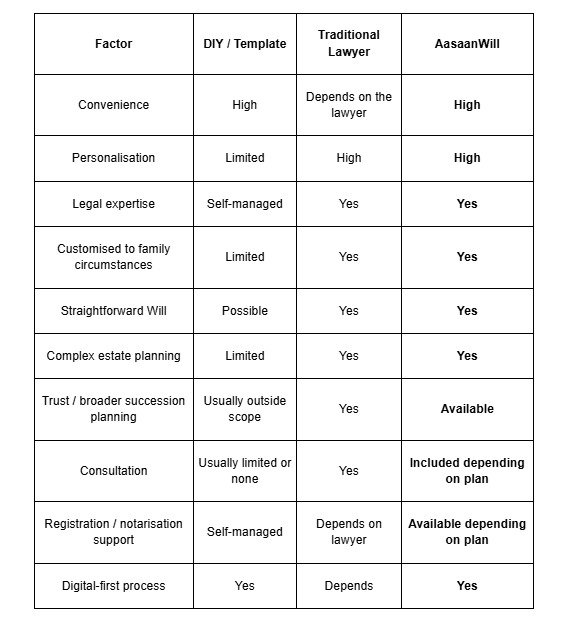
The key difference is that “online” does not have to mean “DIY.”
A service can use technology to make the process more convenient while still providing personalised legal expertise.
When Should You Consider a More Comprehensive Estate Plan?
A Will may be sufficient for many families. But you may need to think beyond a basic Will when your estate or family circumstances involve more moving parts.
For example, you may want to explore broader estate planning if:
You own a family business and want to plan for its succession.
You have substantial assets that need to be managed across generations.
You have property or financial assets in multiple countries.
You want to establish a Trust for specific beneficiaries or purposes.
Your family circumstances are complex or potentially contentious.
You want to coordinate your Will with nominations, ownership structures and other succession documents.
You want to ensure that assets are managed according to a longer-term family plan rather than simply distributed after death.
In such situations, the goal should not be to find the cheapest way to create a Will.
It should be to create an estate plan that actually works for your family and your assets.
What About Will Registration?

Registration of a Will is optional under Indian law.
A Will does not become valid simply because it is registered, and an unregistered Will is not automatically invalid.
Registration creates an official record of the document, but it does not by itself prevent the Will from being challenged. The Will must still satisfy the applicable requirements for execution and attestation, and questions about its genuineness or validity can still arise.
Whether you choose to register your Will is therefore a separate consideration from whether the Will has been properly drafted and executed.
AasaanWill provides registration or notarisation support under applicable plans, helping clients complete the process correctly.
How Do You Decide Which Estate-Planning Route Is Right for You?
Start with your circumstances, rather than simply comparing prices.
If you have a straightforward family structure and relatively uncomplicated assets, a Will may be all you need.
If you have more complex assets, family circumstances, business interests or cross-border considerations, you may need a more comprehensive estate-planning approach.
And you don't necessarily have to choose between a convenient online process and professional legal expertise.
A professionally guided service can provide both.
AasaanWill's Approach to Estate Planning
At AasaanWill, every Will is customised around the client's individual circumstances rather than treating estate planning as a one-size-fits-all exercise.
Our services cover both straightforward and complex requirements, including:
Customised Wills
Registered and Notarised Wills
Premium Will services
NRI Wills
Trust and Family Trust planning
Power of Attorney
Living Wills
Gift Deeds
Legal Heir Certificates
Succession and inheritance planning
Other estate-planning requirements
Where a client's situation requires a broader solution, the focus is on identifying the appropriate structure rather than trying to force every situation into a standard Will.
Conclusion: You Don't Have to Choose Between Online Convenience and Legal Expertise
The question isn't simply “Do I need a lawyer, or can I make my Will online?”
The better question is:
“Who can help me create an estate plan that actually fits my family, my assets and my wishes?”
A DIY template may work for some straightforward situations. A dedicated legal engagement may be appropriate for highly specialised matters.
But there is also a third approach: a professionally guided estate-planning service that combines digital convenience with legal expertise and personalised drafting.
That's the approach AasaanWill takes.
Whether you need a straightforward Will, a more complex succession plan, a Trust or a combination of estate-planning solutions, the objective is the same: to create a clear, customised plan for what happens to your wealth and assets and make it easier for your family to carry out your wishes.
Frequently Asked Questions
1. Do I need a lawyer to make a Will in India?
No. A lawyer is not legally required merely to make an ordinary Will. The Will must, however, satisfy the applicable requirements for execution and attestation.
2. Is an online Will legally valid in India?
An online process does not determine whether a Will is valid. A Will created through an online service can be legally valid if it is properly drafted, executed and attested in accordance with the applicable law.
3. Is a DIY Will as good as a professionally drafted Will?
Not necessarily. A DIY Will can be valid, but the person creating it is responsible for identifying and addressing their own circumstances. Professional drafting can help identify issues, clarify intentions and customise the Will to the individual's family and assets.
4. What is the advantage of using AasaanWill instead of a DIY Will?
AasaanWill combines the convenience of an online process with legal expertise. Each Will is customised to the client's family, assets, wishes and circumstances rather than being treated as a generic template.
5. When should I consider a Trust instead of a Will?
A Trust serves a different purpose from a Will and may be appropriate where assets need to be held and managed for specified beneficiaries or objectives. Whether a Trust is appropriate depends on the family's circumstances, assets and long-term goals.
6. Can AasaanWill handle complex estate-planning requirements?
Yes. AasaanWill works with both straightforward and complex succession requirements, including customised Wills, Trusts and broader estate-planning solutions.
7. Do I need to register my Will?
No. Registration of a Will is optional. Registration can provide an official record of the document, but it does not by itself make a Will valid or prevent it from being challenged.
8. Can a registered Will still be challenged?
Yes. Registration does not make a Will immune from challenge. A court can still examine whether the Will was properly executed and attested and whether there are circumstances affecting its validity or genuineness.
9. Is notarisation required for a Will?
Notarisation is not a general legal requirement for the validity of an ordinary Will. It is separate from the statutory requirements for execution and attestation.
10. Can an NRI make a Will through AasaanWill?
Yes, AasaanWill offers NRI Will services. The appropriate approach depends on the client's assets, country of residence, family circumstances and the laws that may apply to the estate.
11. What if I have property or assets in multiple countries?
Cross-border estates can involve additional succession, ownership and tax considerations. A Will or broader estate plan should take these circumstances into account rather than relying on a generic template.
12. Can a Will cover business succession?
A Will can address assets and interests that form part of a person's estate, but business succession can involve additional considerations. Depending on the structure and circumstances, a broader succession plan may be appropriate.
13. Can I have both a Will and a Trust?
Yes. A Will and a Trust serve different purposes and can sometimes form part of the same broader estate plan. Whether both are appropriate depends on the individual's circumstances and objectives.
14. Does hiring a lawyer guarantee that my Will cannot be challenged?
No. No drafting process can guarantee that a Will will never be challenged. Proper drafting, execution and documentation can help reduce uncertainty and address potential issues, but a Will can still be challenged.
15. How do I know whether I need a Will or a broader estate plan?
Consider the complexity of your family, assets, business interests, international holdings and long-term objectives. If your requirements extend beyond simply deciding who should inherit your assets, a broader estate-planning discussion may be appropriate.
Disclaimer:
This article is for general informational purposes only and does not constitute legal advice. The information presented reflects the law as of the date of publication. For advice on your specific situation, please consult a qualified advocate.
If you’re unsure whether your situation needs a lawyer or an online Will service, talk it through with AasaanWill. Get started with AasaanWill today.
Get in touch with us
Not sure about anything? We are just one phone call away. Book a free 15 minute consultation.

+91-8764447848
+91-8919084868

+91-8764447848
+91-8919084868
AasaanWill’s Privacy Commitment to you
We never use your data without your consent, or sell it to a third party.